CONVERSATION
A Conversation About Writing and Citing with Justice and Charity
Stuart Glennan
Butler University
Federica Russo
Utrecht University
Abstract
Citational injustice often refers to the underrepresentation or misrepresentation of the work of members of marginalized populations within academic publications. The literature emphasises how these unjust practices reproduce and perpetuate known hierarchies and colonial power structures. While these are global trends that impact all academic disciplines, a full understanding of them requires considering how these practices play out within specific disciplinary contexts. In this conversation, Stuart Glennan and Federica Russo draw on their experiences as philosophers of science in the Global North to reflect on sources of citational injustice in their field. The conversation highlights how technologies have changed norms and habits regarding citational practices and points to charity as a key value to foster just practices, both in author and in reviewer roles. The authors consider how a path to more just citational practices may hinge on reconceiving what counts as a “good” philosophy paper.
Keywords: citational justice; charity; Philosopher’s Index; peer review; writing pedagogy; generative artificial intelligence in research
How to cite this article: Glennan, Stuart, and Federica Russo. 2026. A Conversation About Writing and Citing with Justice and Charity. KULA: Knowledge Creation, Dissemination, and Preservation Studies 9(1). https://doi.org/10.18357/kula.312
Submitted: 27 March 2025 Accepted: 05 June 2025 Published: 19 January 2026
Competing interests and funding: The authors have no competing interests to declare.
Copyright: © 2026 The Author(s). This is an open-access article distributed under the terms of the Creative Commons Attribution 4.0 International License (CC BY 4.0), which permits unrestricted use, distribution, and reproduction in any medium, provided the original author and source are credited. See http://creativecommons.org/licenses/by/4.0/.
Introduction
This is a conversation between two philosophers of science, Stuart Glennan and Federica Russo. We have known each other for many years and have often discussed the challenges of conducting philosophical research. We have thought about what makes for worthwhile research, how best to support junior colleagues, how to referee well, and many other topics.
Stuart is the Harry Ice Professor of Philosophy at Butler University in Indianapolis, Indiana, where he has taught continuously since receiving his PhD from the University of Chicago in 1992. While Stuart has been fortunate to maintain an active research program, he teaches in a small department with no graduate program, and much of his work has been devoted to undergraduate teaching and to academic administration. In addition to his work in philosophy, Stuart currently directs Butler’s Science, Technology, and Environmental Studies program.
Federica is Professor of Philosophy and Ethics of Techno-Science at Utrecht University, where she also holds the Westerdijk Chair, named after Johanna Westerdijk, the first female full professor in the Netherlands. Federica has managed to maintain an active research record even during her years at the University of Amsterdam, where she had a considerable teaching load. She has always put a lot of effort into serving the profession through numerous editorial projects, organisation of conferences, and mentoring junior colleagues.
Together, we conducted this conversation over Zoom, beginning with notes we had prepared in advance, but letting the conversation lead us where it would. We’ve added headings and notes and edited for clarity but have largely let the conversation speak for itself.1
Although questions of citational injustice have been implicit in earlier conversations we have had, we never addressed them explicitly, or in the framing suggested by this special issue. It was therefore a relevant exercise for us to step back and reflect on our epistemic practices at a different level, and from another perspective. As will become clear through the conversation below, our interest is not in identifying specific cases, but rather in trying to understand which aspects of research—from technologies for reference retrieval to norms related to argumentation—influence these practices. Far from justifying an “anything goes” approach, our conversation shows that it is important to recover an old but too often ignored principle of argumentation: charity. We plead for more charity in the way we read, cite, and also review. Charity, together with responsibility, can be conducive to more just ways of engaging with other people’s work.
Technology and the Evolution of Citation Practices
FEDERICA. Stuart, you mentioned in conversation some time ago The Philosopher’s Index (Figure 1), which is probably unknown to nearly all junior scholars in our field. Can you explain what that is?
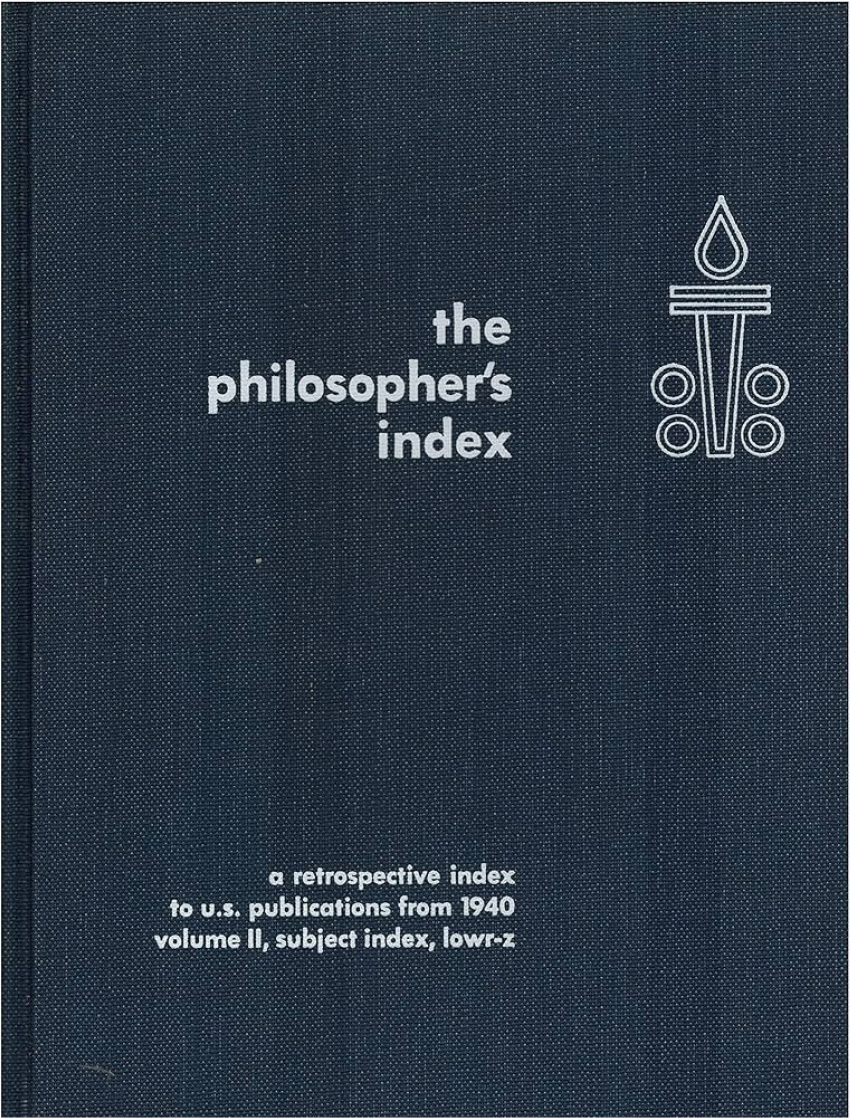
Figure 1: Cover of a volume from The Philosopher’s Index, 1978. Image from Amazon.
STUART. Sure. I got my PhD in 1992. We didn’t have internet browsers or online databases. The best way at that time to find out who was writing about what was to go to The Philosopher’s Index. It was a massive book—thousands of pages—updated each year. You could look up keywords or authors. It was only available at well-funded university libraries. There still is a Philosopher’s Index. It’s an online system now, and more widely available. I still use it.
When I left graduate school and came to Butler, I had to live with a small library that didn’t have The Philosopher’s Index and had only a few of the journals in my field. Journals were still in paper, so if I wanted to find out what people were writing, I had to drive an hour and a half to Bloomington [home of Indiana University], where I’d pull The Philosopher’s Index off the shelf and start paging through it. I’d hope I’d found the right things and then I’d wander through the stacks of the library trying to locate them. I could also use my library for interlibrary loan, but I’d get the documents three weeks later. The long and short of it was that it was really hard to find out what other people were doing.
FEDERICA. Yeah, that’s true. Interestingly, I’m also old enough to remember what The Philosopher’s Index is because I used it once, for my bachelor’s thesis. Afterwards, I moved to online search systems. But maybe the question is: How do you think software reference managers, and the possibility of online search, has changed the way in which we find out about our colleagues’ work? What is your insight about this?
STUART. Well, the first thing is that we have so much more opportunity to know what people are doing. If you compare the number of citations in papers written in the 1970s or ’80s with those written now, it’s just night and day. One of my colleagues who knew we were talking pointed me to Jerry Fodor’s classic paper “Special Sciences” (1974). There are just two citations in the paper; the first one appears more than halfway through, and most of the work he’s responding to isn’t even mentioned. This is characteristic of the time. The only way you knew what to read was if you knew the people writing, or if your teachers told you. Or maybe you could look in indexes of books to find stuff—but it was haphazard.
So the new technologies just give us such very different abilities to find and access materials. I go back to the fact that I work at a place where we do not own a lot of the more expensive journals. Now there are technologies that help us get around this problem. Everything is indexed, and interlibrary loan is quick and easy. And now we have preprint archives that allow us to find papers that might be behind paywalls. So scholars from places with fewer resources have a much better chance of being part of the conversation.
How do these technologies look to you from your research perch?
FEDERICA. So while you were offering these considerations, Stuart, I was thinking that it is as if we live in a paradox. On the one hand, we have way more opportunities and means and tools to access the literature; but at the same time, it doesn’t look like our citation practices, which are the theme of this conversation and of the special issue for that matter, have likewise improved. So maybe we have to decouple how we access the literature from how we use that literature, although of course having access to the literature is the starting point.
STUART. Yeah. I guess I would say that in one sense our citation practices have improved pretty unequivocally, and that is we cite more people. It is easier when reading a paper written by a philosopher of science in 2010 to figure out who they’re talking about than it is reading a paper written in 1980. But that does not mean that people are citing all the relevant people. Certainly, that would be very difficult to do. Sometimes choices may reflect a set of biases, and that’s a serious issue. Another thing is they might be using the material they cite in ways which may not be fully appropriate. And so I do agree that while these technologies give us opportunities, they also create a new set of perils.
FEDERICA. I like the point that you make about how these citation practices have changed, because this is something that I noticed, and I’ve been increasingly alerting my students about how certain norms have changed in fields, in the plural, and in our specific field, the philosophy of science. I often give the example of an iconic paper for everyone [in philosophy of science], which is [W. V.] Quine’s “Two Dogmas of Empiricism” (1951), which, in my view, would be rejected outright nowadays, according to our standards, because indeed it doesn’t cite enough. And I think if you read anything before the 1980s, or ’70s, that there was way less of a culture of being specific about which authors you are referring to. Authors were broader and vaguer in referring to schools of thought or thinking of other authors. And I think a lot of the work was given to the reader rather than the author to compile this reading list.2
STUART. Right. That’s a nice way of putting it. And I think that it speaks to a kind of clubbiness which could be very exclusionary in the way in which philosophy is conducted. I was just working with a set of my students reading Elizabeth Anscombe’s “Causality and Determination” (1971). It’s a classic piece, and I realized it was completely beyond them to know who she was talking about. They had to have someone like me and say, “Oh, that’s that, and that’s that.” And I can hand them more recent papers and that is not a problem.
If I could switch gears a little bit. I want to turn to another kind of technology that has impacted our work in the last twenty years or so, which is the growth of a lot of non-refereed forms of work, especially blogs, which are sometimes important in directing what people are thinking about in the field. I wonder if you have any thoughts about how these are valuable, and also whether there are any particular parallels in the way in which those things refer to or fail to occur to people.
FEDERICA. That’s a very good point, Stuart, because my impression is that philosophy has been very slow in admitting non-academic sources as legitimate or valuable sources for discussion. And I do have these conversations with my students at different levels about how to include them. And there are two issues there. One is how to formally cite these pieces. And I think it is now easier because, thanks to reference managers, it is pretty standardized. So it is way easier [than before the advent of reference managers] to cite a blog post or to cite even a thread on X or Twitter, or things like that.3 But the other point, I think, has to do with what kind of contributions they are really making to the philosophical thinking that we are engaging with. And this is an interesting point, I would say, and we have to be more open, in my view, to allow for these non-academic sources to inform our philosophical work. We have to be able to say the way in which they are relevant, why they are relevant, how we make them relevant, how we engage with these sources. But they cannot be excluded outright, in my view. What is your take on that?
STUART. Yeah, I agree with that. The argument that we should not consider those things is that those aren’t peer reviewed, that they aren’t sufficiently rigorous, and so on. But I don’t think this is a good argument, especially for people like us who are concerned with the philosophy of science in practice. One of the things we need to recognize is that much of the practice of science, which we’re seeking to understand, does not go on in peer-reviewed journals. And so to understand these processes, both socially and systemically, we need to take these things seriously. Or at least we shouldn’t be excluded from taking these things seriously. And so I guess my major concern would be not so much that one always has to look at this kind of stuff, but that it would be considered inappropriate for us to use these kinds of sources to understand certain kinds of phenomena.
FEDERICA. I agree with your point here. If we are interested in the practice [of science], then we have to be able to look at the practice from multiple perspectives. And excluding these non-academic sources seems wrong because we are excluding part of the epistemic process. Indeed, they aren’t all there is about science, but they are also not to be neglected and put under the carpet. So we need to strike a good balance between the use of both, and perhaps even understand how conversations that happen at the non-academic level end up in the academic discourse that is mediated by the peer review system.
Citation Practices and Peer Review
STUART. Right, right. If I could move us on to a related question, so far we’ve been talking about what’s cited and what should be cited and what we’re failing to cite. But I’d like maybe to turn to your thoughts on the ways in which we actually use the work we cite in our papers, and in how we do that well. And I know that you’ve thought a lot about argumentation theory and what counts as a sort of good philosophical paper. I know that you’ve been an editor of a journal4 and have been called on in that place to make editorial decisions about what are the appropriate kinds of pieces to accept and also appropriate kinds of expectations. So I wonder if you could talk a little bit about that.
FEDERICA. Thank you for bringing this up, Stuart. I am finding an interesting connection between argumentation theory and our practice of writing philosophical papers, in part because we often conceive of philosophy as the pinnacle of how we provide an argument. And so I started considering that there are different strategies in how we set up our philosophical papers. And if you look at the literature in argumentation theory, especially feminist approaches or virtue-based approaches, then you realize that you can use citations for different purposes. For instance, your whole argument could be geared towards demolishing a single point,5 perhaps based on a specific sentence in footnote five on page nineteen. But this may ignore the larger, broader, or deeper goals of one’s contribution, which may be a whole book.
Your paper could be instead trying to be constructive and build on existing literature. So you don’t need to engage specifically with that chapter in that book in a very narrow way, but you’d need to use some existing work to advance it. It is well possible that a constructive argument is less precise, but it is more courageous; however, how we reward this courage in advancing thinking sometimes is not reflected in the peer review system, because indeed, we go back to what we were saying a moment ago about the precision of the argument or the precision in using the sources. So I have been thinking about how we [should] set up the narrative of a paper really depends on the goals of our argument, including when we think that an author’s argument is incorrect. The goal should not be to prove them wrong for the sake of “winning the argument,” but to advance knowledge in some other way. I often miss this constructive component after we have gone through the “destructive part.” And this is still very, very common in philosophy: We value the “negative result” paper. How do we get out of the negative result culture?
STUART. Yes. I agree with basically all of what you said here. One of the things that’s striking to me is that this comes back to a very old principle of philosophy, which is the principle of charity. That, I take it, is a principle that assumes that the people who you might disagree with have intelligent things to say and that the object of philosophical work is not to show that those people are wrong, but instead [is] to advance our understanding of whatever [the topic] is.
Because of some teaching I’ve been doing, I have been reading some ancient philosophy and thinking about Plato’s dialogues and [Socrates’s] criticisms of the Sophists. I think that some of those criticisms ring very true when looking at some contemporary philosophical work. I think the problem goes back to editorial practices. A lot of refereeing amounts to trying to make people write papers that are bulletproof. Philosophers are encouraged to write papers that make one clear, precise point where you can say, “Well, there’s the point.” And so it is easier to do that, as you say, if your point is negative than if you’re pointing to positive considerations. And what that tends to do is to lead us into some real narrowing [of conversations]. We fall into rabbit holes—topics where there can be long citation chains discussing where this paper did this, and then this [other] paper did that. It becomes very scholastic.
FEDERICA. What I find intriguing in how our conversation is unfolding is that we started discussing citation practices and how we come up with what we have to cite. We haven’t touched yet upon forms of citational injustice. But, interestingly, we are already pointing at the broader picture, which is what we want to do with our papers and how citations should serve this goal. So clearly, if the goal is to advance knowledge, to contribute to thinking forward, etc., then your citations should support this goal. But if your goal is narrow, just [to make] one specific point, and even more specifically to prove that part of the work of that specific author is incorrect, then all of your citation practice will be geared towards this. So I like that we are putting on the table the broader goal that we should pursue as philosophers and perhaps as academics. Maybe this goes beyond philosophy.
Forms of Citational Injustice
FEDERICA. Our conversation went high up, mentioning goals of writing papers and doing philosophy. Maybe this is a good moment to return down to earth and discuss more concretely how we can commit injustices. Do you think you have any idea of an easy list that we can give?
STUART. Let me count the ways. But to begin I want to admit that, although I have long been concerned with citational injustice, I’ve almost certainly committed it at times. It’s difficult not to, given the way our profession works, and we may commit injustices without meaning to. So I want to approach this from a place of humility.
With that said, I do have a kind of list of some things which I might throw out here. The first and most obvious [injustice] is simply failing to cite someone whose work is relevant to your paper; you may have some citations, but there are other works that you may well know are there, but you just don’t bother to cite them. This could be particularly frustrating when you cite someone who has made a point recently, and you can look and find that a very similar point was made earlier by someone else. That’s the simplest kind of injustice.
A second thing is that you can cite work but fail to properly or sympathetically or charitably represent the content of this work. So, you know, there may be certain standard stories about what some work says, and [it] is convenient for you to refer to that standard story. So you mention a paper and just assert a claim about philosopher X believing Y. But it may turn out that there is a controversy about whether philosopher X believes Y. And it may be that philosopher X does not agree with this representation of their work. I think you and I can both fill in some X’s and Y’s here. So especially if you’re citing a philosopher to criticize them, I think it’s pretty important that you do more than simply mention the text and say, “This is what they said.” You need to take a moment to engage sympathetically with the words that they’ve written rather than treat them as a straw man.
Another kind of citational injustice that I think is interesting is something we’ve already hinted at in the opening, which is a failure to cite or to explain inside jokes or terminology that can make certain arguments less intelligible to outsiders. One of the things that’s important about a philosophy paper is you want to make its point as transparent to readers as is possible. I have an example of this problem which you will recognize, since you know quite a bit about the causation literature: It’s something called the “Canberra Plan.” The funny thing is that if you try to find out what the Canberra Plan is, there are no papers on it. It’s just a kind of inside joke of a set of philosophers. I think the people who talked about it were perfectly well-meaning. But, if you don’t know the story, it’s hard to track down. That’s a problem. And that can be especially hard for people who have less access to the folks who are in on the joke . . . I see you’re laughing at this one.
FEDERICA. I’m laughing because of course I know about the Canberra Plan . . . because this is what I’ve been trained in. And then, when I wrote the causality book with Phyllis [Illari], published in 2014, and I had forgotten about it.6 She reminded me about the Canberra Plan, which is really important to understand developments in the philosophical literature about causality. And so we explained what that is in that book. You came up with an excellent example of it [inside jokes and terminology].
STUART. But the interesting thing is, I bet you had a hard time finding particular papers to cite.
FEDERICA. Exactly! It was impossible. In fact, you really had to have a broader understanding of what philosophy of language was at that time and how it has influenced the philosophical literature on causality in philosophy of science. And then you could make sense of what the Canberra Plan is. Otherwise, that’s not possible.7
STUART. Right. I guess I’ll mention one other kind of particularly important kind of citational injustice. Given the great mass of literature out there, someone aspiring to figure out what they should care about and what they are going to talk about [regarding some philosophical topic] will often go to reference works of various kinds, most obviously the Stanford Encyclopedia of Philosophy, which has a huge influence at this point, but also things like the Oxford Handbooks or the Cambridge or Routledge Companion series. And one of the things that can happen there is if the authors of these reference works omit things and focus the discourse narrowly on a few topics and texts, then those choices will tend to propagate in some very strong ways. This is something you’ll always need to worry about if you’re an author or editor doing this kind of work—a kind of work both you and I have done. We need to be very careful that we are inclusive in those contexts.
Promoting More Just Citation Practices
STUART. So are there other categories that you might add to my list?
FEDERICA. I’m not sure I have more categories. But I wanted to react to a couple of things you said. The first one: I thought it was interesting when you said we don’t cite important things that we should be citing. And earlier on, we said that when we write our papers, we should apply charity in the way we comment on other people’s work. It seems to me that the same applies when we write referee reports. So if I’m refereeing a paper and I notice you did not cite this paper or this whole literature, there may be two reasons. One is that you genuinely did not know about it, or you simply forgot about it; the other is that you deliberately did not cite it. But of course, I cannot know from the reviewer’s perspective, so I could phrase my report in two ways. One is to accuse you of ignoring this literature; or I could suggest that you bring it in because it would add value to your paper. And so I would like just to add that there is the flip side of the coin. You know, just as I have to be charitable in the way I write my paper, I should also be charitable in the way I write my referee report, because maybe there is an opportunity for [the author] to learn if you collegiately suggest something that they should read. What do you think?
STUART. Well, absolutely. And bringing that up reminds me of two recent referee reports I’ve gotten on papers. For the first one I was writing in an area where I was crossing over into—metaphysics—which is not really my field. And so I was in danger of saying some dumb things. I got a lovely referee report back from somebody who made a series of helpful observations on related literature, and said, “Oh, by the way, do you know about this?” They mentioned a book that had come out twenty years earlier that I had never heard of, which really anticipated a lot of the points that I was making. I went and got the book, and I was able to acknowledge it, draw on some of its points, and explain how my view diverged in some respects. The reviewer recognized that I was coming from a different area. I brought something different, my philosophy of science background, into a metaphysics debate. They were very charitable in trying to reach across that boundary to make some progress.
I’ve also had the converse happen—with a referee accusingly asking, “Why haven’t you cited this?” I hadn’t cited the material because I didn’t think it was germane to the paper, and frankly I didn’t think it was very good. It was one of those negative result papers. The demand that you talk about another paper making a different point (perhaps because the referee likes the point) is just not helpful.
FEDERICA. These two are excellent examples of how we could really make a difference in the way we engage with each other’s work, even behind the scenes.
The other thing that really got my attention, and I comment on this because both of us are interested in improving the practice and preventing citational injustice, is the challenge of making sense of the whole body of work of an author, especially those of us who are active over a long period.
Our thinking evolves. And it’s not that we reject totally what we wrote ten or fifteen years ago, but clearly our thinking has changed, and it has moved on. So do we have to strive for a kind of internal coherence in our work over the span of fifteen or twenty years, or how do you think we could aid to do justice to the development of our thinking, but also be fair and notice that this thinking has evolved? Is there a way in which, in our writing, we could strike a balance between these two things without accusing an author of contradicting themself?
STUART. Right. You know well, Federica, that I have been doing this for a long time and that people have sometimes written about my early work and ignored my later work. I’ve changed my mind in certain ways, and I’ve evolved. I think there’s two sides to this. One is the question of your responsibility as an author. And the other is your responsibility as a reader.
I think your responsibility as an author is that when you really have changed your mind about something, you should be clear that you’ve done so. Also, if you haven’t exactly changed your mind, but you have recognized that certain things you said were not completely clear. It’s good to acknowledge the problems and make the clarifications. What you don’t want to do as an author is to insist you were always right or entirely consistent. That’s contrary to the spirit of philosophical investigation. This topic makes me think of Hilary Putnam, who was famous for changing his mind. Do you know about Daniel Dennett’s Philosophical Lexicon (1987)?8 He defined the putnam as a unit marking the number of times a philosopher changes their mind.
FEDERICA. I know about that.
STUART. I’d be the first to admit that I’m a few putnams from the views found in my earliest papers. That’s part of my responsibility as an author.
But the reader also has responsibility. If you’re a reader in a world in which it’s pretty easy to find out what people have written, you should take care to pay attention to the range of an author’s work, especially if you are being critical. Criticizing a twenty-five-year-old piece when there’s something written by that same author in the last five years and on the same topic generally isn’t the best idea. Certainly there can be reasons why it’s appropriate to say, “Here’s this interesting view back in the 1990s that I want to talk about.” That’s okay. But you need to be sensitive to the new work. And if what you’re doing is raising a criticism of that position an author may have revised, you aren’t advancing the ball.
One of the things that happens is that certain stories get told about what certain authors believe that are based on old material or are simply uncharitable readings; then they get repeated and entrenched in the literature. And so people may well be citing an author, but the critical interpretation they give isn’t based upon their own reading but on “what’s said” about the author. The source of the critical view isn’t always clear, and its accuracy is not challenged. That’s clearly a problem.
FEDERICA. Thanks. Interesting. Stuart, let me react to what you just said. Also moving towards another topic that is very dear to us, which is how we can improve on these citation practices. It seems to me that in what you just said, there are at least two key elements. One is responsibility: As authors, as reviewers, as readers, we have a responsibility to the profession. The second element is positionality, which is something that we don’t make explicit enough in our work. We sometimes act as if ideas fall from the sky instead of explaining how we come to that idea for the paper and how this is part of longer-term thinking, which may include changing our mind. If we were allowed to discuss not just abstract formulations of our ideas, but also more personal contextualisation of them, that would help with exercising “responsibility,” but that obviously means that this kind of contextualisation and positionality would be allowed in the current canon of philosophical papers. And then you had another point: Maybe it is not written in the papers (in the plural), but it is easy to find out [e.g., via debates at conferences, or blog posts]. So we go back to something we said earlier: How to cite other sources, like blog posts, discussions on social media, or perhaps a keynote that you are giving at a conference. And often there isn’t a paper reporting on the changes in our thinking, and yet there are multiple ways in which we let the community know, and we should be able to retrieve and use this information. And so there is a question of responsibility of, again, how we write and how we build up the argument and therefore how we construct our citation practices.
But then let me ask you, what would be your golden tips for your students to cite well?
STUART. Well I’m not sure I have a golden tip or silver bullet. I think the biggest thing is that you need to read what you cite. Obviously, because we want to cite broadly and we want to acknowledge others’ work, we do not probably have time to read everything that we cite—certainly not well. But especially if you want to criticize a position, you need to read those you criticize carefully and charitably.
There are many purposes to citation. One is to give credit, and another is to identify a target for critique. I think it’s best to err on the side of expansiveness in giving credit. You may have not exactly characterized someone’s position or contribution, but that’s OK. You have broadened the conversation. But if you are going to engage in something that’s critical, then you need to be more careful. And also, I think, getting back to the historical point, that your criticisms should take into account current views of the people that you’re criticizing, unless you’re simply making a historical point.
FEDERICA. The way in which such criticism is phrased is also important; this goes back to the question of charity. So instead of constructing an argument that directly attacks the author or the author’s view, you could phrase it conditionally: If you are saying this, then this other thing would follow. And this is something that I’ve been discussing with my students as well. Now, if you [as an author] follow this way of structuring the argument, you open up the possibility that you are wrong [in your reconstruction of the argument], you know, and this can be corrected. So in the context of a paper, then there could be a rebuttal that says, “No, actually you took me wrong.” And then you really advance the debate. But imagine that you are constructing an argument like this in a conference or in a seminar setting; the conditional formulation allows a possibility for the person who is criticized to say, “Oh, no, that’s actually not what I meant.” And again, it can be a constructive conversation rather than a confrontational one. So it may seem like just politeness, but in fact, to me, these are strategies that acknowledge that I could be wrong in the way I set up my argument. Right?
STUART. Right, right. Conditionalization is an ancient strategy. And it’s part of how we learn to talk constructively with people we disagree with. One of the reasons that we can learn a lot from studying the history of philosophy is that we can observe that certain arguments are profoundly plausible once we accept their premises, even if in the present day some of the premises seem clearly off base–teaching Descartes or something like that. There’s lots of ways that he can be criticized in the light of what we now know about the brain and psychology. But the fact is that if you grant him a few assumptions which are not implausible on their face, you can get to a lot of the conclusions. And those are very informative lessons for us to learn. And while my example is from the history of philosophy, we can use the same strategy for 2020 as we do for 1648.
FEDERICA. True. Very true. What I’m finding interesting is how the conversation is turning now to the value in studying the history of philosophy and the history of thinking and also to revisiting our argumentative strategies and our citation practices. So it seems to me that we are not saying anything terribly new, but hopefully it is still valuable because we easily lose sight of these lessons.
STUART. I want to go back to what you said about positionality. I don’t think the point you’ve raised is that original, but it is important because it contrasts with a particular feature of the analytic style of philosophy and analytic approaches to philosophy of science, which tend to be ahistorical. They tend to be ahistorical both with respect to their claims about the nature of science and in their approach to philosophical argumentation. And part of what you’re doing with your talking about positionality is bringing in a set of other ideas which are important in other philosophical traditions, from which I think the people trained in the analytic tradition could benefit.
FEDERICA. Absolutely, yes. And I think this has to do, again, with what we take the nature of philosophical argumentation to be. And I like that philosophers of science like us have been increasingly engaging with science and technology studies, also to be able to include aspects of the scientific practice that is not just reducible to the higher order philosophical argumentation or reconstruction of scientific rationality. It’s very interesting how this conversation is unfolding.
Citation Practices in the Era of GenAI
FEDERICA. Perhaps, to get to a close, Stuart, we should look back to where we started because, in a sense, The Philosopher’s Index was a technology [to facilitate] citation. What do you think is happening now with artificial intelligence? I know this is a huge topic, but do you have some ideas of how AI is going to or is currently changing our citation practices?
STUART. Right. There’s so much we could say. But let’s focus on the way that gen AI is altering how we search for and understand the work of other philosophers. You can ask ChatGPT for a summary of a paper, or of a philosopher’s views, and you’ll get one. But these summaries don’t come with quotations and citations, or occasionally they do, and they may be made up.
Like any kind of machine learning algorithm, the LLMs [large language models] that are answering our questions are trained on a mishmash of material on the web. If I were to ask it about what philosopher X has to say about Y, the answer will encode whatever biases there are on the web. So if we have a certain (potentially misguided) sort of story about how to think about a certain philosopher’s work, AI will just iterate and repeat it.
I think the first thing to do is to be aware that whatever the LLM tells us may reinforce citational injustices. But, more importantly, thinking about AI may help us recognize why we want to try to preserve a set of citation practices that are, in a sense, very old. I don’t want to say that our current processes are ancient. Because if I go back and look at the history of citations, you know, much of what we do is really a feature of twentieth-century technologies and so on. But there’s a big idea that we need to explain where we got things from. It’s something that we can do and which AI systems struggle with. It is both valuable and distinctly human.
FEDERICA. Absolutely. So I think it is important that we mention that we are having this conversation in March 2025! Not very long ago, we had a session with the librarian at my university as part of the HPS [history and philosophy of science] master’s program about generative AI in education and in research. And interestingly, there are now versions of LLMs that are more specialized for research and that can give you the references. So at least the chances that they hallucinate are reduced. At the same time, it strikes me that these systems will not reach the level of contextualization, awareness, and inner knowledge that you are pointing to—the positionality and the contextualization that a humanities field does require. So I think, in the closing of the conversation, it is important to bear in mind that these citation practices are bound to change because of the introduction of these technologies. And yet everything we said until now remains valid, or perhaps is even more important than ever, because we can’t outsource to a machine the explanation of the rationale behind our citation choices and strategies.
STUART. Yes, I totally agree with that. And, you know, the point that our citation practices and, more broadly, our research practices are always going to change is very appropriate. We’re probably at a moment of more revolutionary change than almost any in the history of scholarship, and so we shouldn’t think that our citation practices should be static. But I do think that our intellectual history depends on a very long history of citation practices. I am thinking back to antiquity, to Aristotle’s reflections on the pre-Socratics, to the work in the House of Wisdom, and so on. Our work as thinkers must begin with our trying to charitably and clearly understand and acknowledge the thoughts of others. And I think that that principle can be a kind of fixed point, even as we accept that what citations will look like twenty years from now will be different from what they look like today.
FEDERICA. Yes, indeed. So maybe we need to have another conversation about citation practices in a couple of years, and then in ten years, and then in twenty years, and see how things have changed!
STUART. I’ll look forward to it!
Conclusion
Looking back at the transcript of our conversation, we see a few important themes emerge. One is that our citation practices are shaped by technologies and by institutional and professional norms, and that as those technologies and norms change, our practices will inevitably evolve. But another is that our citation practices must be scrutinized in light of the goals and values of our academic inquiry—values like justice and charity that should remain fixed even as our practices change. The history of philosophy has sometimes been characterized as “the great conversation,” and we can think of just citation practices as ways of inviting people from different times, places, and viewpoints into that conversation. But, as we emphasized in our dialog, just citation practices are not just about who or how much we cite, but about how we treat the ideas of the people we cite. The conversation can only be great if it begins with listening.
We hope that our dialog will inspire readers to their own conversations with colleagues and students about their citational practices and the values embodied in them. It’s a conversation that we would all benefit from having.
Acknowledgements
We greatly enjoyed engaging in this conversation and we are most grateful to Sally Wyatt for advising us on the set up of the project, and for comments on earlier versions of this text. We also thank Samantha MacFarlane for her careful editorial work. Last, but not least, our gratitude goes to Carl Craver and to Phyllis Illari for sharing thoughts and ideas with us on these themes.
References
Anscombe, Gertrude Elizabeth Margaret. 1971. Causality and Determination: An Inaugural Lecture. Cambridge University Press.
Dennett, Daniel, ed. 1987. The Philosophical Lexicon. 8th ed. American Philosophical Association.
Fodor, J. A. 1974. “Special Sciences (or: The Disunity of Science as a Working Hypothesis).” Synthese 28 (2): 97–115. https://doi.org/10.1007/BF00485230.
Illari, Phyllis McKay, and Federica Russo. 2014. Causality: Philosophical Theory Meets Scientific Practice. Oxford University Press.
Quine, W. V. 1951. “Main Trends in Recent Philosophy: Two Dogmas of Empiricism.” The Philosophical Review 60 (1): 20–43. https://doi.org/10.2307/2181906.
Footnotes
1 In the spirit of citational justice, we want to acknowledge that many themes in this conversation first came up in earlier conversations we had with two other colleagues, Carl Craver and Phyllis Illari, who have done much to shape our thinking on these topics.
2 It is also worth noting that citation practices vary across subfields in philosophy. A widely used categorisation is between “analytic philosophy” and “continental philosophy.” The first is often associated with Anglo-American authors and their contribution to philosophy of language, philosophical logic, and certain strands in philosophy of science. The second is often associated with philosophers based in the European mainland, especially France, and contributing to historical epistemology or sociology of knowledge. Analytic philosophers cite more and differently than continental philosophers—and while the term “continental” refers to European (especially French) philosophy, there are lots of “continental” philosophers in the English-speaking world, and lots of Europeans who write in an analytic style. Another interesting trend is the way that philosophers have come to emulate natural and social scientists in using author-date citation styles. Philosophy journals have almost exclusively switched over to this approach (with the Journal of Philosophy being a notable holdout), but this possibly started with philosophers of science.
3 In our conversation, Wikipedia did not come up, and this would deserve a separate discussion. For instance, there is the question of how authoritative a source Wikipedia is compared to a classic printed encyclopedia or the Stanford Encyclopedia of Philosophy.
4 Federica Russo was Editor-in-Chief of the European Journal for Philosophy of Science between 2017 and 2021 (with Phyllis Illari), and she is currently Editor-in-Chief of Digital Society.
5 The equivocal phrasing here provides an opportunity to clarify that large part of analytic philosophy and of Anglo-American philosophy of science follows the maxim “one paper, one idea.” Thus, the critical target is often the specific idea put forward in that paper. At the same time, this strategy may quickly convert into ad hominem arguments.
6 More than forgetting about it, my research had moved away from that approach, going in the direction of philosophy of science in practice.
7 Just to let our readers in on the joke, Canberra planning is an approach to understanding what philosophers call conceptual analysis. The approach was developed largely by Australian philosophers, some of whom were based at the Australian National University in Canberra. It’s also relevant to the joke that Canberra was a planned city, built as a new capital on previously sparsely populated lands.
8 The Philosophical Lexicon was a list of puns based upon the names of prominent (mostly twentieth-century, mostly analytic) philosophers, compiled by Daniel Dennett. The number of insider jokes you get is a fair measure of how well read you are in the analytic philosophy canon. While we think the ribbing is good spirited, given the theme of this issue we should acknowledge how many of these jokes and who we get to joke about depends upon insider knowledge and standing, and thus may prove a point of epistemic injustice.